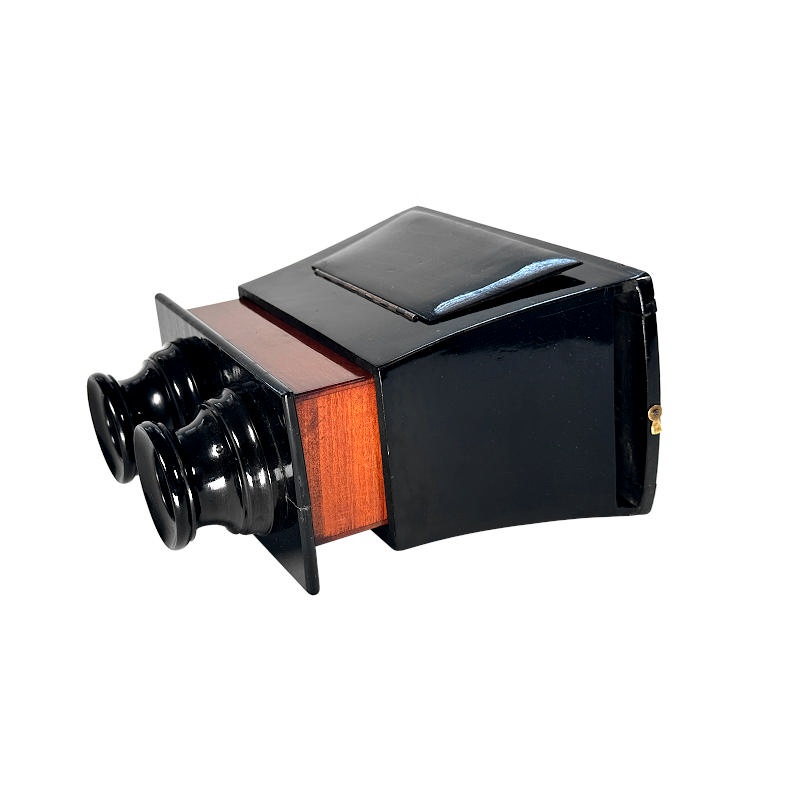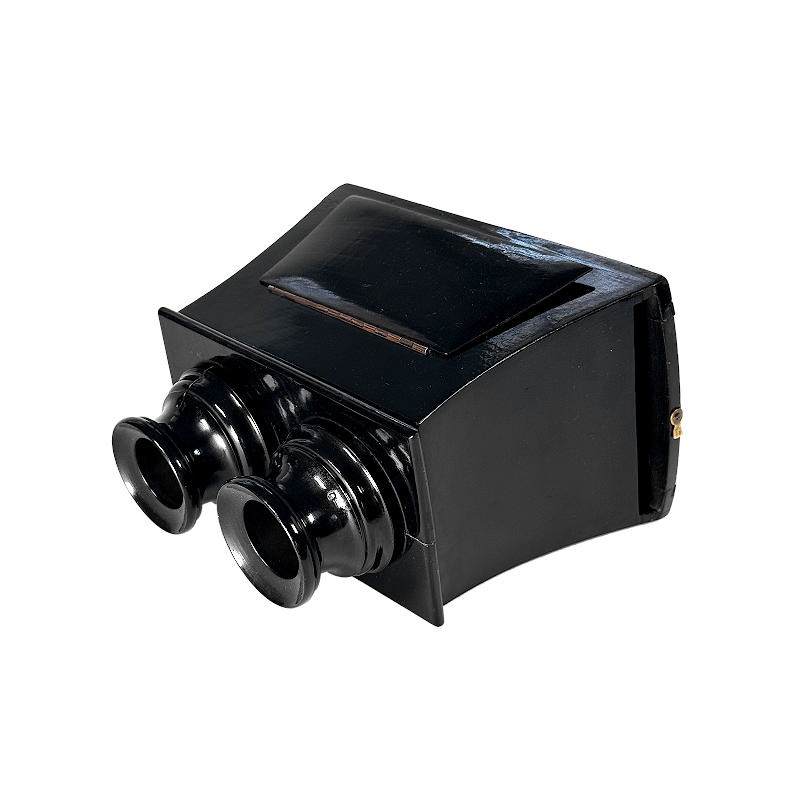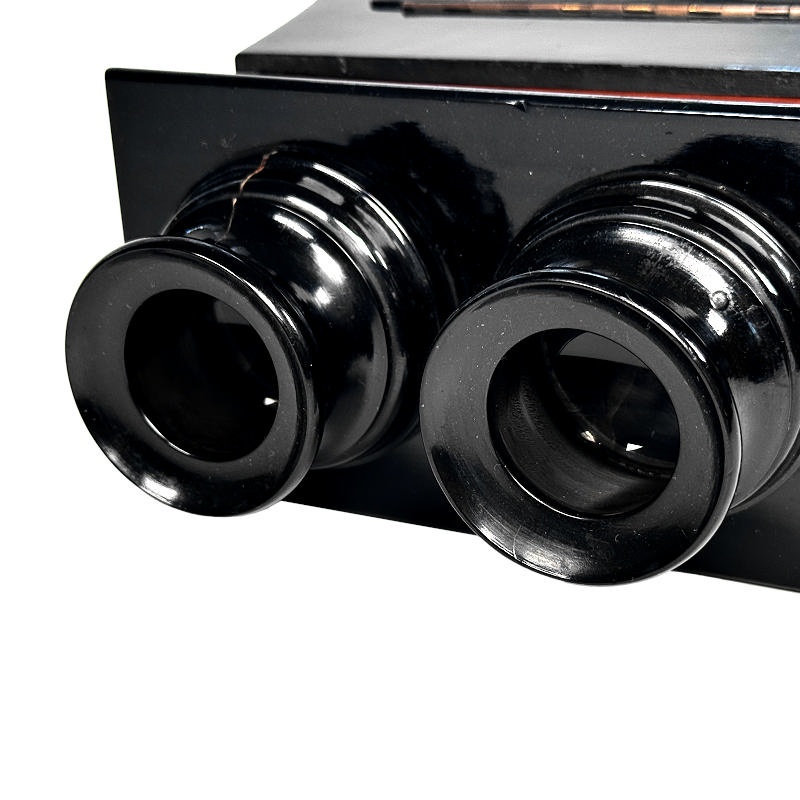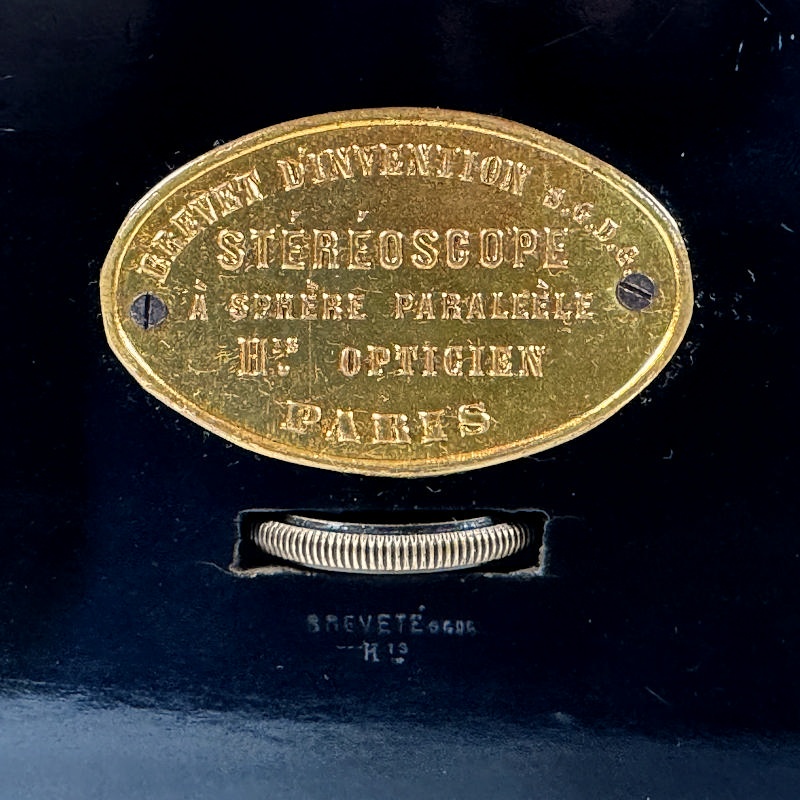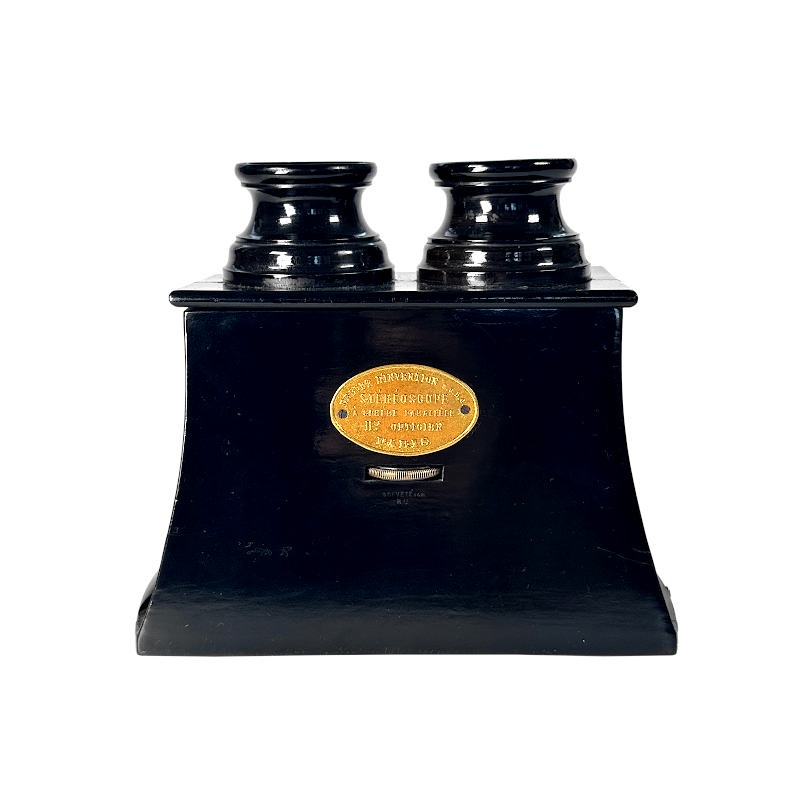
Stereoscope ‘à sphères parallèles’
Details
Jules Fleury, known as Fleury Hermagis, born in 1835, was an optician and the son of Hyacinthe Hermagis. In 1864, he took over his father’s business, a company specializing in precision optics and general photographic supplies, located at 18 Rue Rambuteau in Paris and founded in 1845.
After the Universal Exhibition in London and the development of stereoscopy in France, the optician became interested in the phenomenon and filed a first patent (FR34,862, December 26, 1857) for a stereoscope with parallel spheres, intended to improve stereoscopic vision and reduce eye strain and image distortions caused by prisms.
A presentation of the invention took place at the French Photographic Society during the meeting of February 19, 1858. A second presentation followed on December 21, 1858, by Fleury Hermagis himself, helping to clarify the exchanges between Hermagis and Claudet, the latter claiming priority in the use of lenses instead of prisms in stereoscopes.
In 1865, Fleury-Hermagis filed a new patent (FR69,519, November 29, 1865) for a system of combined lenses, a more complex but more effective optical system.
In the 20th century, Hermagis marketed the products of Mattey under its own label.
(from: Moulinier et al. Histoires de visionneuses stéréoscopiques françaises. Limoges, 2025, pp. 73–74. Author’s translation.)
Date Made
Place Made
Period
Type
Manufacturer
Technique
Format
Medium
Related Patent
Additional information or corrections are very welcome. Please send an e‑mail to mail@stereoscopicmuseum.org.