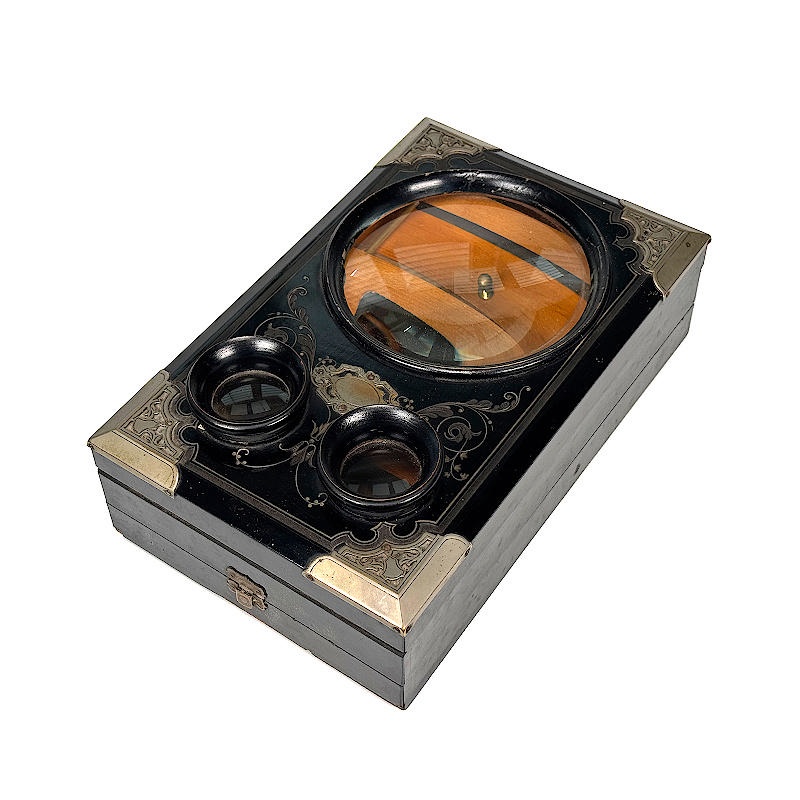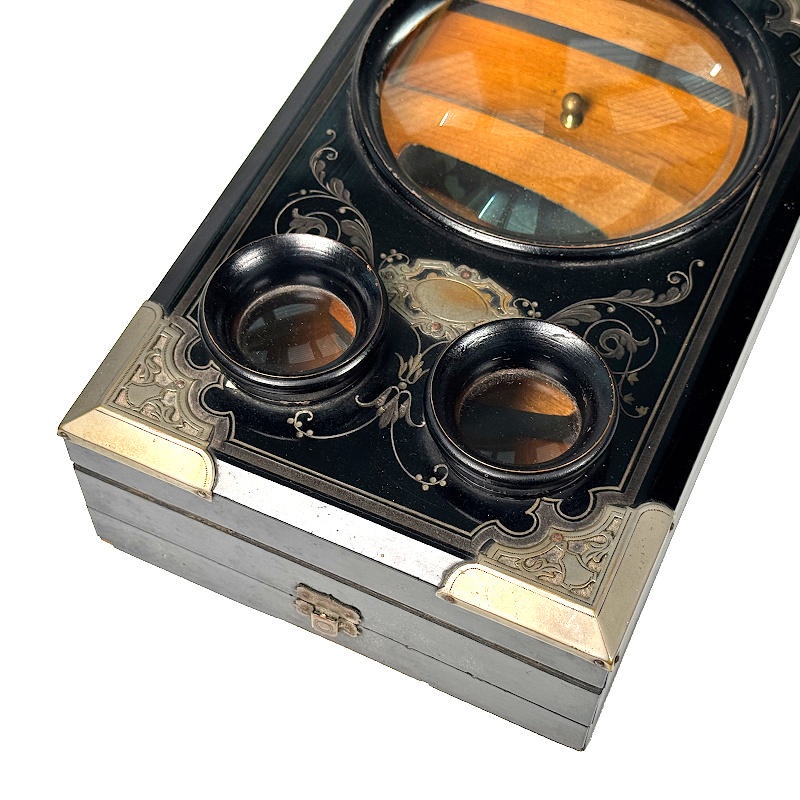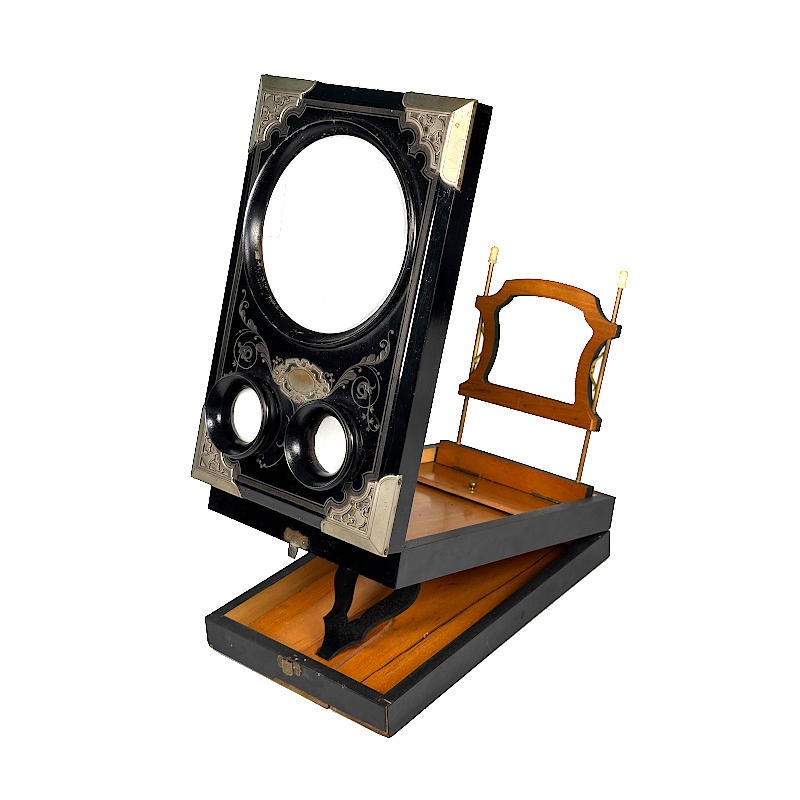
Foldable Pantoscope ‘à double socle’, Metal Fittings
Historical Context
Although much of the history of French stereoscope manufacturers has been uncovered, the development of the Pantoscope remains obscure.
Pantoscopes are clearly the French response to English Graphoscopes. While we know that Mattey was the last manufacturer, little is known about the origins. Mattey’s predecessors Fouquet and Wytenhove appear to have been involved in both the development and the creation of the rich variety of shapes and decorative styles. However, it is often impossible to determine the manufacturer of a specific pantoscope.
Details
A pantoscope is a compact, partially foldable viewer equipped with both stereoscopic lenses and a large magnification lens, allowing the viewing of both mono and stereo images. They were mostly produced ‘à double socle’ with a simple rectangular body, which allowed for easier adjustment of the viewing angle, though more elaborate shapes were sometimes offered.
Pantoscopes were available in a wide range of decorative styles, including painted designs, carvings, and inlays of wood, metal, mother-of-pearl, and other materials.
Date Made
Place Made
Period
Type
attributed to
Technique
Format
Medium
Additional information or corrections are very welcome. Please send an e‑mail to mail@stereoscopicmuseum.org.