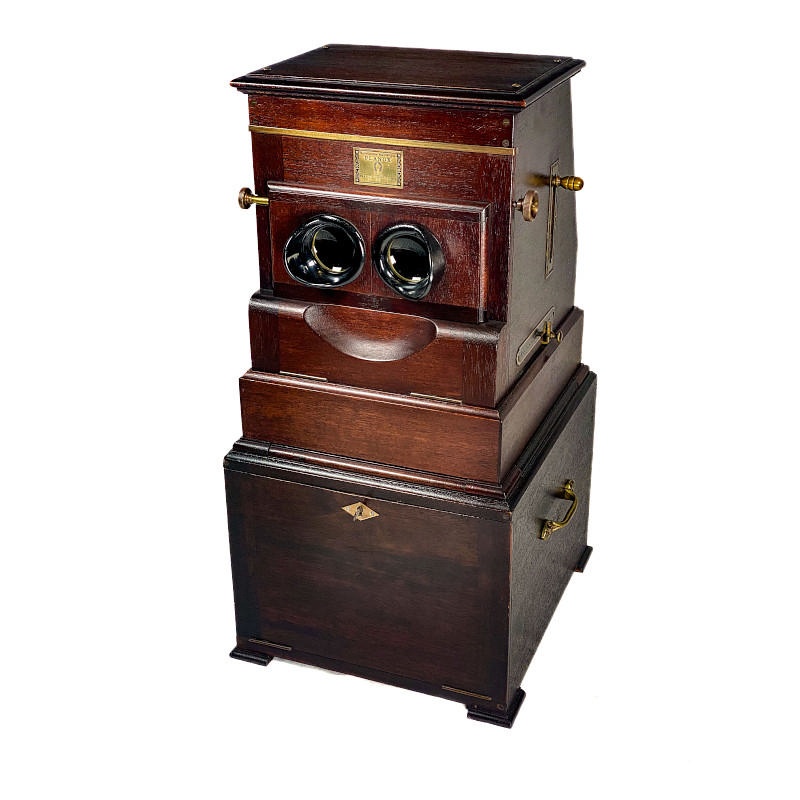
Tray-Stereoscope ‘Planox’, First Version
Historical Context
The ‘Planox Stéréoscope Magnétique’ was one of the most popular French stereo viewers and is notable for its innovative magnetic mechanism. The basic idea was developed by Modeste Noel, who registered his patents in 1913 and 1914. Alexandre Plocq was likely the first to use Noel’s invention for production models. The drawings of a third patent in 1920, again by Noel, show the simplified mechanism found in the viewers that were actually produced. Later versions made use of bakelite trays instead of wooden trays.
Details
A wooden tray containing 20 glass slides can be inserted by flipping down the front of the viewer, then, by moving a knob, located on the right side, up and down, one slide after another can be examined. The slides are pulled up by magnets which connect to metal strips attached to the glass slides. Below the knob, a brass arrow will point to the number of the slide that’s in view and allows navigation to a specific slide. For that, the knob has to be stopped at an intermediate position, which unlocks the tray movement. This position is also required to exchange the tray.
The viewer has a detachable base containing two drawers with three trays each, making it possible to store a total of 120 slides.
Date Made
Place Made
Period
Type
Manufacturer
Designer
Technique
Format
Medium
Related Patent
Series Title
Additional information or corrections are very welcome. Please send an e‑mail to mail@stereoscopicmuseum.org.