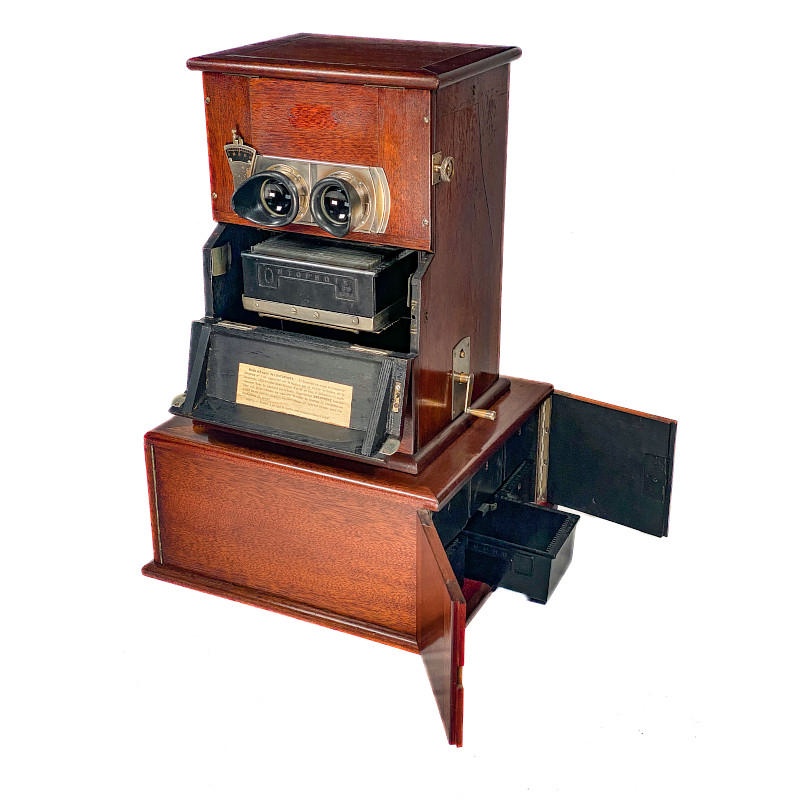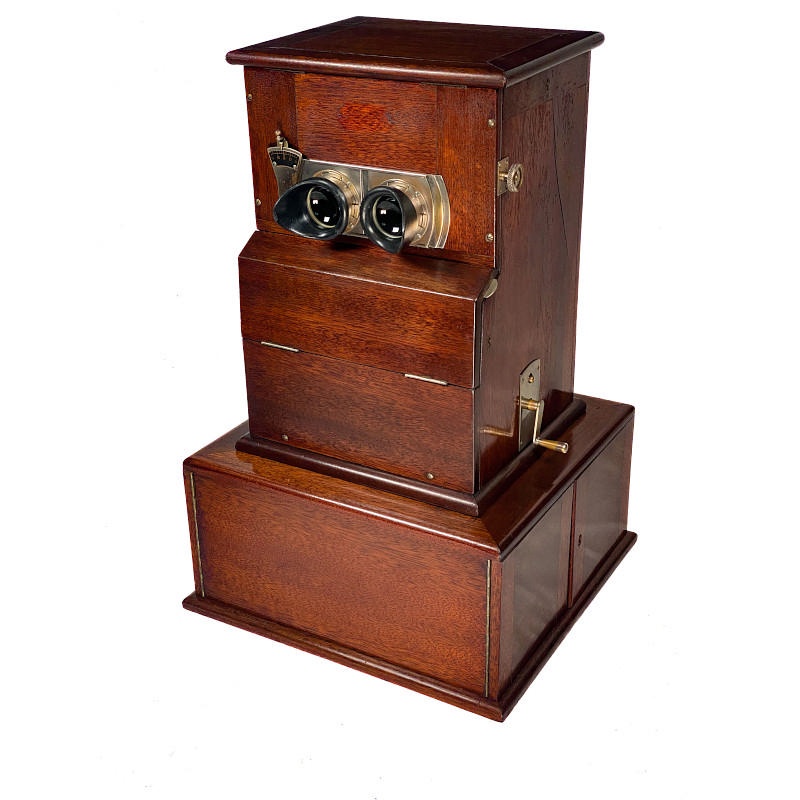
Tray-Stereoscope ‘Ontophote Classeur-Automatique’
Historical Context
Gustave Cornu was a mechanic. He worked for a time for Jules Richard before leaving at the beginning of the First World War to establish his own company. In 1916, he filed a patent, along with several additions and improvements, and built and marketed a stereoscopic camera called Aéroscope. In 1917, he renamed this device to Ontoscope. The apparatus was produced in two formats, 6x13cm and 45x107mm. To offer a complete range in the field of stereoscopy, he also introduced a stereoscope, complementing the Ontoscope, called the Ontophote. He filed patent FR632.492 for this device on April 8, 1927.
At the end of the 1930s, his son, Gustave Joseph, took over the company. However, stereoscopy no longer held the appeal it once had, even though film had replaced glass plates. Cornu ceased stereoscopic production in 1937 and turned to twin-lens reflex cameras. The company disappeared at the end of the 1950s.
Details
The Ontophote is a multi-view tabletop stereoscope, available for the 6x13cm and 45x107mm formats. It was made of either varnished mahogany or waxed walnut.
A hand-cranked mechanical system allows the user to view sequentially the 20 individual images loaded into an interchangeable tray, with forward or backward movement. The stereoscope features an entirely metal focusing mechanism and a system for adjusting the distance between the eyepieces by means of connecting rods, with the setting indicated on a graduated scale.
The eyepieces are mounted with bayonet fittings and can be interchanged for short‑, medium‑, or long-focus viewing. The Ontophote can be fitted with an illumination lantern attached by two screws at the rear. It can also be converted into a monocular projection lantern by removing the ground-glass and one of the eyepieces, which is then replaced by a projection lens such as a Cindo or Hermagis Series A lens.
As an option, a base was available for storing the image trays.
(from: Moulinier et al. Histoires de visionneuses stéréoscopiques françaises. Limoges, 2025, pp. 55–56. Author’s translation.)
Date Made
Place Made
Period
Type
Manufacturer
Technique
Format
Medium
Related Patent
Additional information or corrections are very welcome. Please send an e‑mail to mail@stereoscopicmuseum.org.