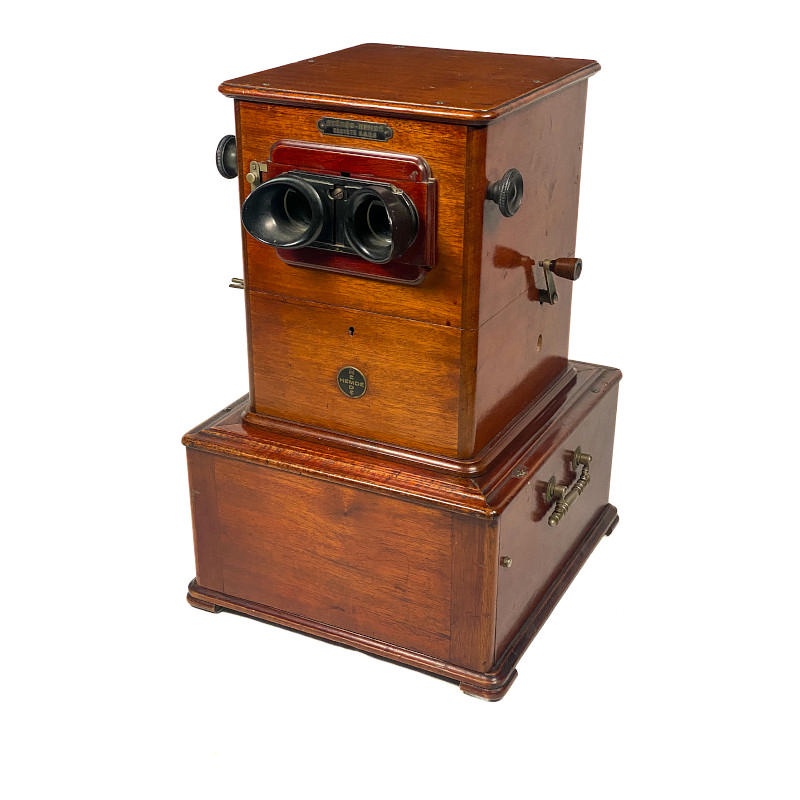
Tray-Stereoscope ‘Série I’
Historical Context
Hemdé was a French trademark for photography accessories and stereoscopes, named after its location in Hem and its founder, Maurice Delécaille. Initially focused on photographic glass plate development, the company patented a stereoscope mechanism in 1907 in collaboration with Émile Cuny and Paul Sorel. After the dissolution of Delécaille’s company in 1909, Sorel continued producing Hemdé stereoscopes. The company ceased operations sometime in the mid-1920s.
One of Hemdé’s specialties was the use of wooden slide trays. Far more important was their crank mechanism incorporating a ingeniously threaded rod that serves for both lifting the slides into viewing position and moving the tray, allowing smooth forward and backward navigation.
Details
The wooden trays contain 25 slides each and can be inserted into the viewer by flipping back its top. Then, by turning a crank on the right side of the housing, one slide after another can be examined. Each half-turn of the crank advances or returns the slides and moves the tray forward. A metal lever integrated into the counter on the left side of the viewer enables free slide navigation. The ‘Série I’ includes a wooden cabinet that holds up to 12 trays, accommodating 300 slides.
‘Hemdé’ viewers are among the rarer tray-stereoscopes, and are testimonies to the remarkable diversity of French stereoscopes.
Further reading: Stereoscopy History Series — Hemdé (A. Ruiter)
Date Made
Place Made
Period
Type
Manufacturer
Technique
Format
Medium
Related Patent
Additional information or corrections are very welcome. Please send an e‑mail to mail@stereoscopicmuseum.org.