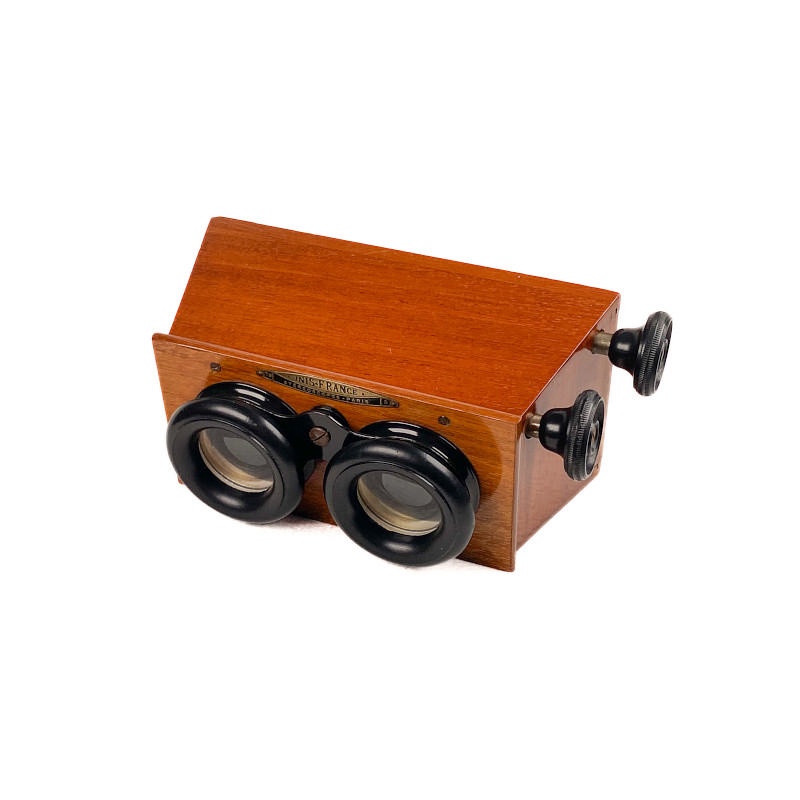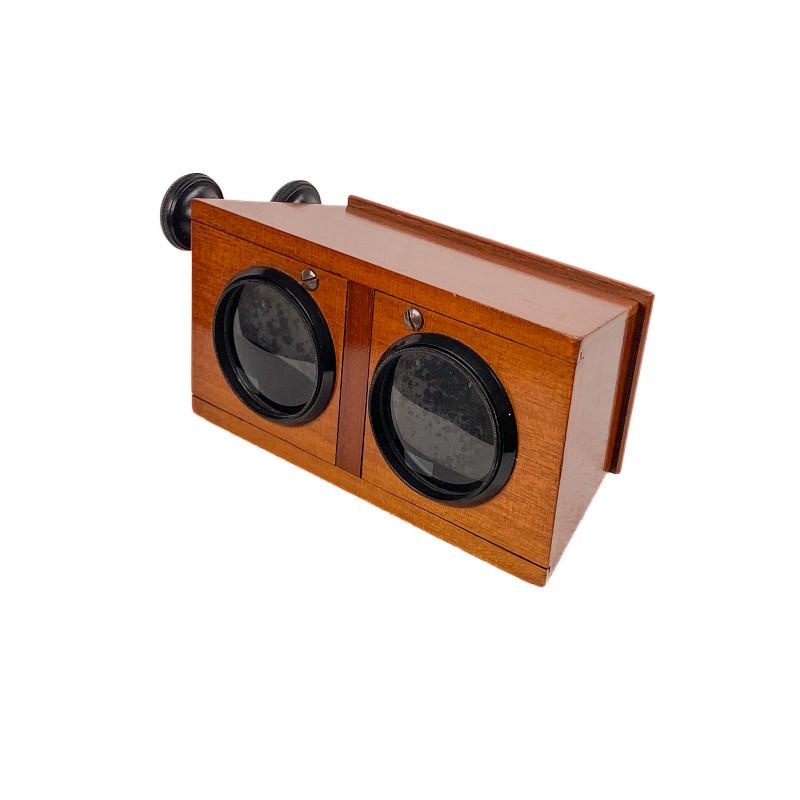
Stereotelescope ‘Le Stéréotélescope’
Details
The Stéréotélescope is a very particular stereoscopic binocular intended for the visualisation of projected stereoscopic images and their resulting dimensions. The construction was realised by the company Mattey père & fils, co-signatory of the patent. The Stéréotélescope was presented to the French Society of Photography during the session of December 4, 1903.
The Stéréotélescope presents itself as an ordinary stereoscope on which the frost would have been exchanged for optics with a varying distance. When the gap of the divergent eyepieces is the same as that of the lenses, we are in the presence of a simple theatre binocular. If we decentralise the lenses to give them a greater gap than that of the eyepieces, the lenses no longer work through their centre but acting as prisms to divert the images, each in an opposite direction, this makes it possible to arrive at the superposition of two stereoscopic images and to have subsequently, the sensation of the relief in the same way as in an ordinary stereoscope, with in addition a strong magnification. During the First World War, the device found medical use for the examination of the stereophotos of the wounded.
(from: Moulinier et al. Histoires de visionneuses stéréoscopiques françaises. Limoges, 2025, p. 103. Author’s translation.)
Date Made
Place Made
Period
Type
Designer
Manufacturer
Technique
Related Patent
Additional information or corrections are very welcome. Please send an e‑mail to mail@stereoscopicmuseum.org.