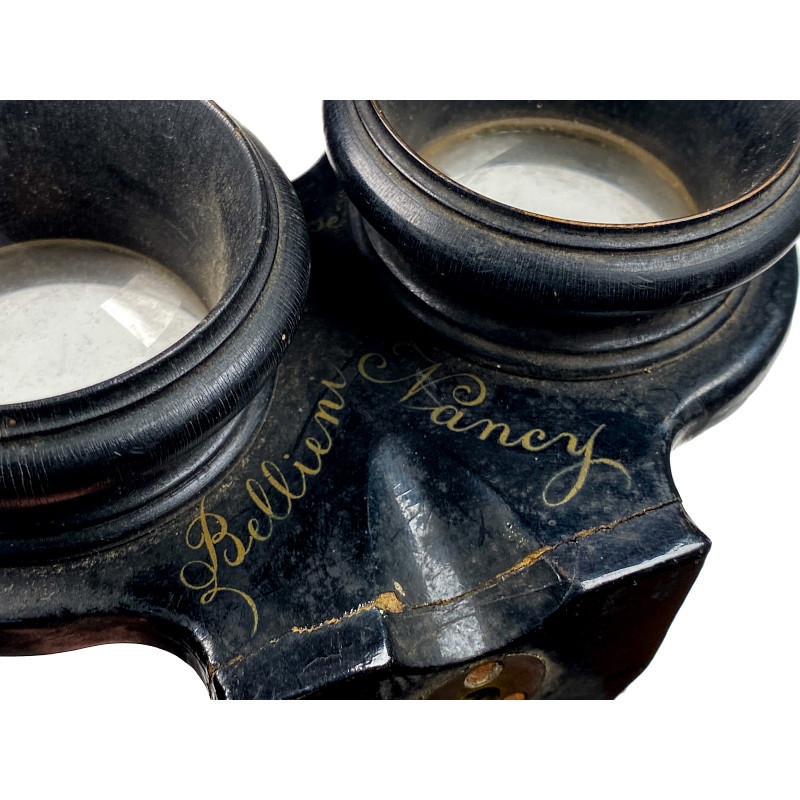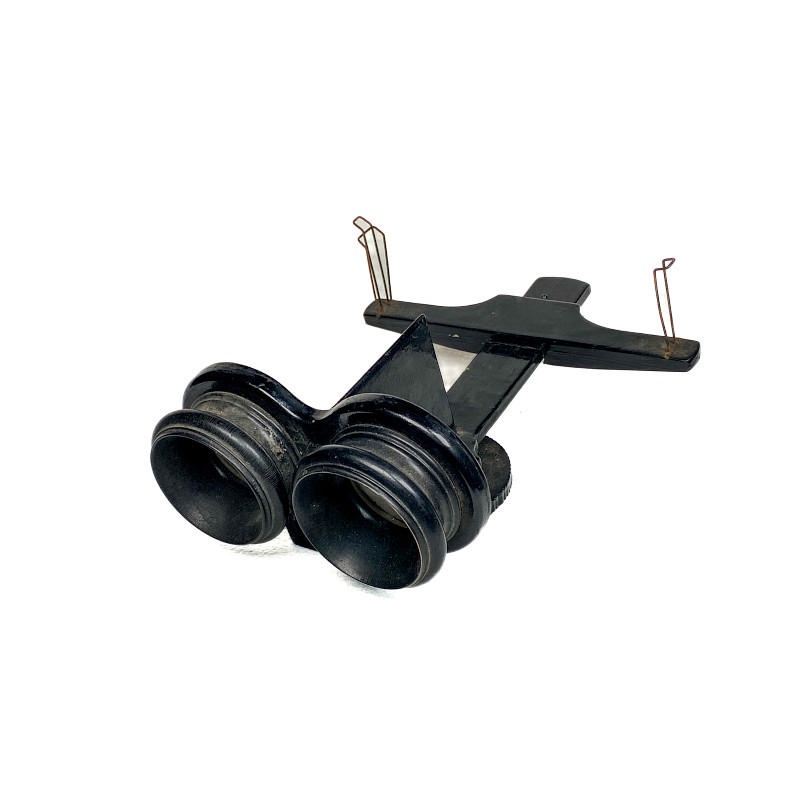
Holmes Stereoscope ‘Stéréoscope à main’
Historical Context
Henri Bellieni was born as Charles Henri Gimel, but took the surname of his stepfather, André François Bellieni, who had Italian roots.
In 1880, Bellieni took over his stepfather’s business in Nancy and focused on the production of cameras. The Jumelles Bellieni gained a strong reputation, and the company’s product range included both conventional cameras and stereo cameras.
During the First World War, the company produced trench periscopes and aerial cameras. After the war, Bellieni retired, and the business was continued by Paul Ritter. The company ultimately remained in operation until 1990.
Details
Bellieni’s stereoscope is a variant of the American Holmes-Bates stereoscope, referred to in France as the “Mexican Stereoscope.” The wooden frame is fitted with a detachable handle, and focus is adjusted by means of a large rotary wheel on the underside. The viewer was also available with a stand.
(from: Compendium of Stereoscopes)
The 1903 Bellieni catalog describes this hand-held stereoscope as being made of lacquered cardboard, with achromatic eyepieces and a rack-and-pinion focusing mechanism operated by a button. Henri Bellieni appears to have intended the device for examining wet stereoscopic plates directly from the laboratory. This use is justified by the double-claw system, which separates the wet image from the ground-glass screen.
(from: Moulinier et al. Histoires de visionneuses stéréoscopiques françaises. Limoges, 2025, p. 43. Author’s translation.)
Date Made
Place Made
Period
Type
Manufacturer
Technique
Format
Medium
Additional information or corrections are very welcome. Please send an e‑mail to mail@stereoscopicmuseum.org.