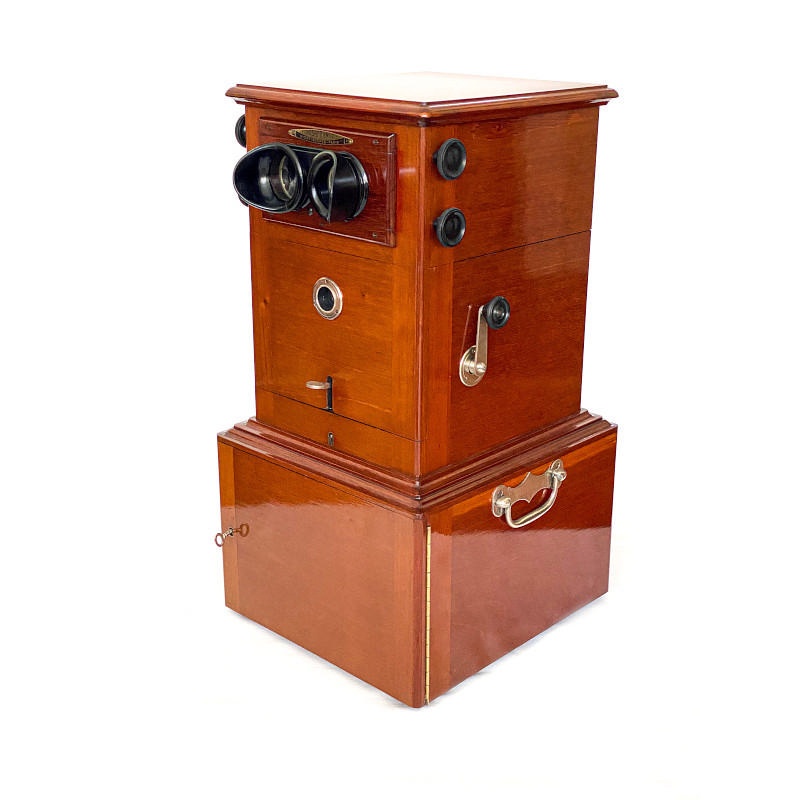
Tray-Stereoscope ‘Le Stéréothèque’
Historical Context
The Stéréothèque was Mattey’s response to the Taxiphote of Jules Richard. For more than twenty years it remained the principal tray-based stereoscope in Mattey’s product range. From 1926 onwards the device was replaced by the Métascope.
The functionality and mechanism of the standard Stéréothèque remained unchanged throughout its production life. A version with short-focus lenses was later introduced under the name Stéréothèque à court foyer.
Details
The top of the Stéréothèque can be opened, after which a slide tray is placed on a sled inside the viewer. On the right side there is a crank. When it is turned 180 degrees clockwise, a slide is lifted from the tray by two metal fingers that rise from the bottom of the viewer and are attached to a vertically mounted circular disc. The stereoview is positioned in front of the lenses and can be viewed.
When the crank is turned another 180 degrees, the slide is returned to the tray and the tray advances slightly so that the next image is selected. At the front there is a small round viewing window through which the number of the selected image can be read. The crank handle can be turned in both directions, allowing bidirectional navigation.
(from: Compendium of Stereoscopes)
Further reading: Stereoscopy History Series — Mattey (A. Ruiter)
Date Made
Place Made
Period
Type
Manufacturer
Technique
Format
Medium
Related Patent
Additional information or corrections are very welcome. Please send an e‑mail to mail@stereoscopicmuseum.org.