Tray-Stereoscope ‘Stéréoscope-Classeur portatif’
Historical Context
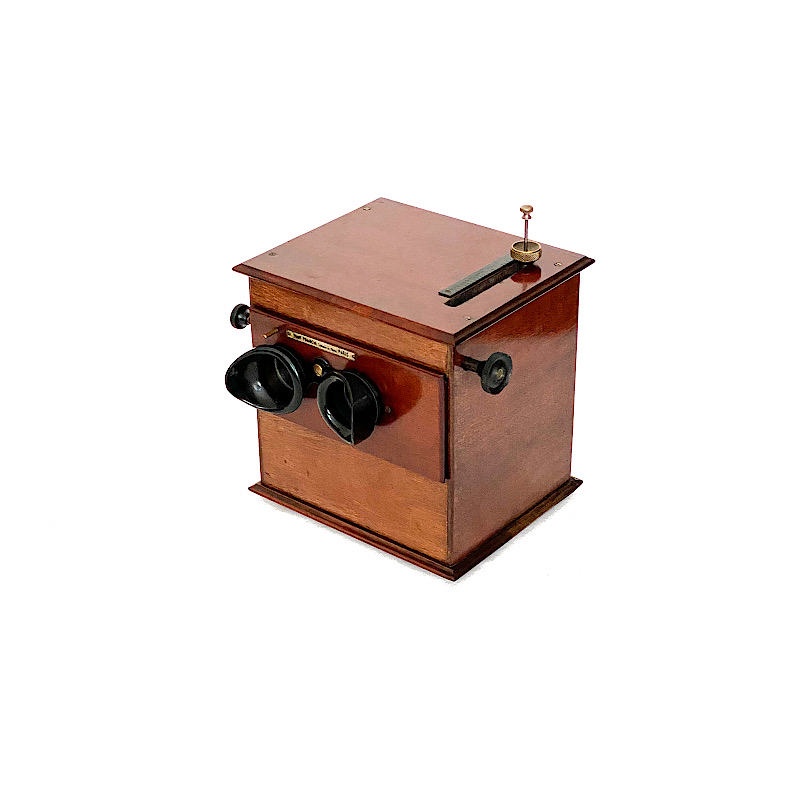
Le Stéréoscope-Classeur Portatif has a unique mechanism. “Portatif” means portable. Although compact, the device is too heavy to be classified as a true hand-held stereoscope.
The viewer was introduced in 1911, but it appears not to have been a commercial success, as it no longer featured in the catalogue of Mackenstein’s successors, Suffize & Molitor, after the First World War. Production probably ceased around 1915, which also explains why the viewer is today a rare collector’s item.
Details
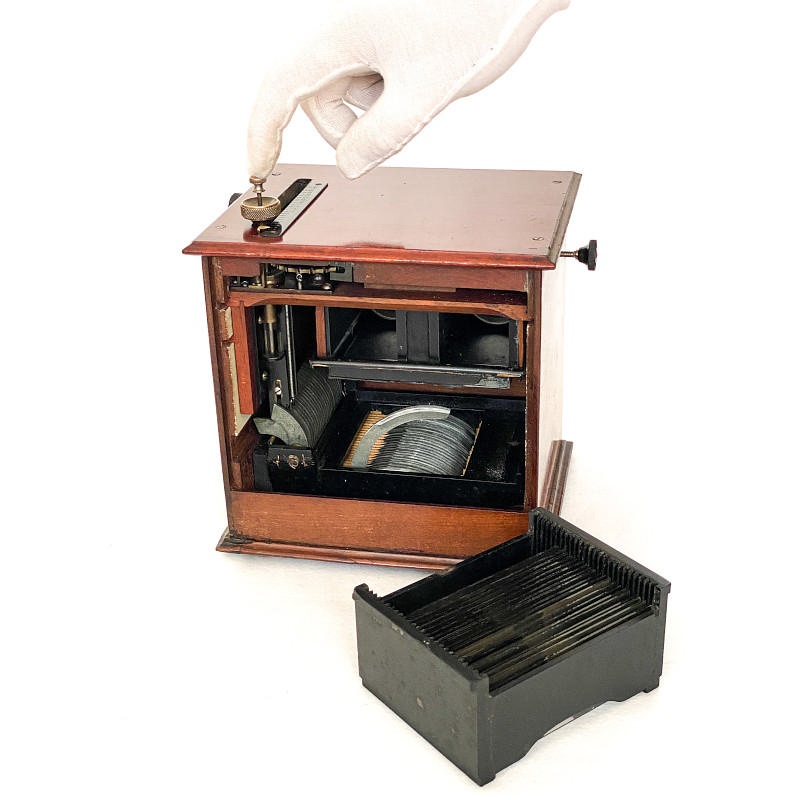
The distinctive feature of this stereoscope is that the tray, which holds 25 glass stereoviews, remains fixed in position while the images are viewed. A turning knob is located on the side. By rotating this knob clockwise or anticlockwise, an image is selected. In doing so, the entire viewing assembly, including lenses and tray, moves. On the top of the viewer, an index with 25 numbers indicates the selected image, accompanied by a push button.
Inside, beneath the tray, is a mechanism with 25 fingers. When the button on top is pressed, the finger corresponding to the selected image is activated and pushes the slide upwards into viewing position before the lenses. Releasing the button returns the image back into the tray.
(from: Compendium of Stereoscopes)
Further reading: Stereoscopy History Series — Mackenstein (A. Ruiter)
Date Made
Place Made
Period
Type
Manufacturer
Technique
Format
Medium
Additional information or corrections are very welcome. Please send an e‑mail to mail@stereoscopicmuseum.org.