Stereoscope ‘Systeme Jahnholtz’
Details
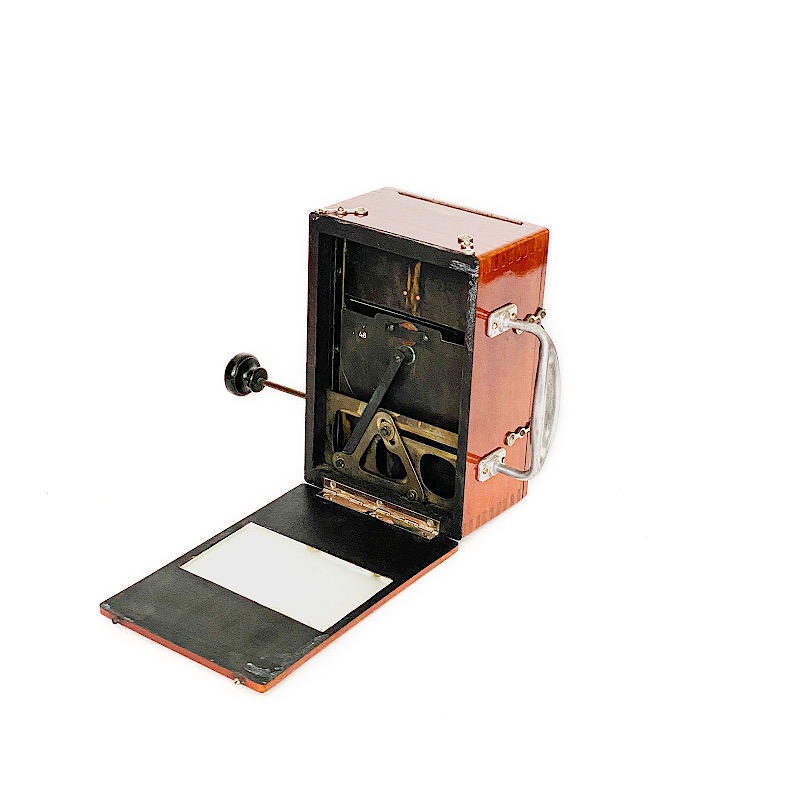
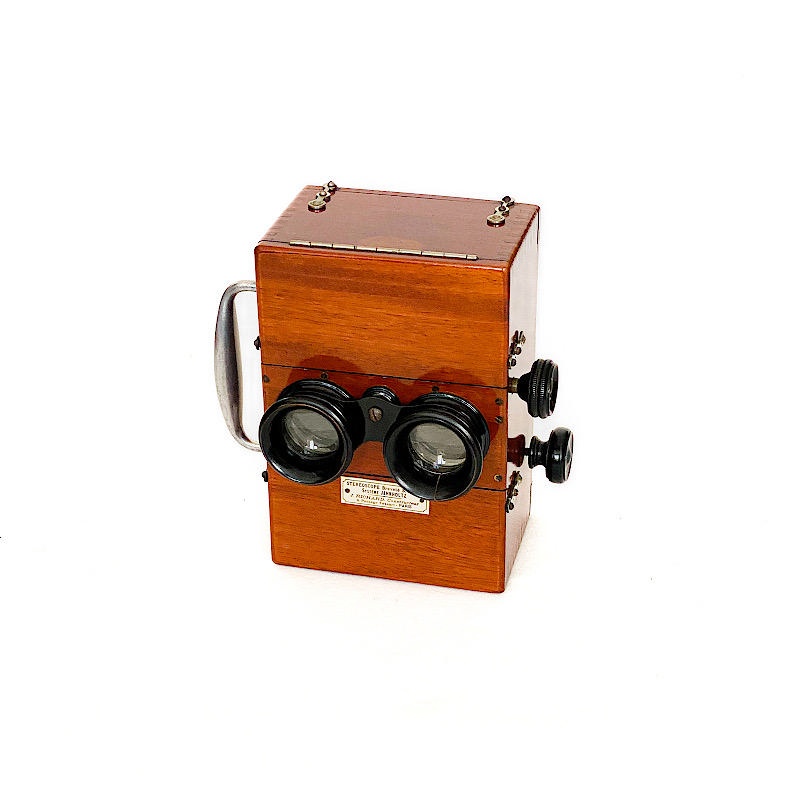
After the fixed-chain models came the push-and-pull stereoscope, in which the views pass from the supply magazine to the receiving magazine after a viewing period, thanks to a changing rod. This system was invented by Hermann-Marie-Camille Jahnholtz, who filed patent FR 280.799 on August 23, 1898, jointly with Jules Richard. The patent was supplemented by an addition dated February 13, 1899, which produced the final version of the device. This system represents Jules Richard’s first concept of a handheld stereoscope allowing the automatic changing of plates by mechanical action.
The stereoscope is a portable type, consisting of a varnished mahogany case fitted with a large metal handle for carrying and for holding it during use. On the front, in the center, is the viewing section with fixed eyepieces and rack-and-pinion focusing controlled by a knob. Above and below are the access doors to the magazines. On the same right-hand side is a pull knob which, when drawn out, removes a stereoscopic plate from the lower supply magazine, raises it into viewing position, and then inserts it into the upper receiving magazine.
The original patent placed the operating knob underneath the instrument. The February 1899 certificate of addition moved it to the side, making the device easier to handle. This stereoscope requires accurately standardized glass plates to ensure proper operation.
Note: Although marketed by Jules Richard, this model does not appear in the manufacturer’s catalogs.
(from: Moulinier et al. Histoires de visionneuses stéréoscopiques françaises. Limoges, 2025, p. 169. Author’s translation.)
Date Made
Place Made
Period
Type
Manufacturer
Technique
Format
Medium
Related Patent
Additional information or corrections are very welcome. Please send an e‑mail to mail@stereoscopicmuseum.org.