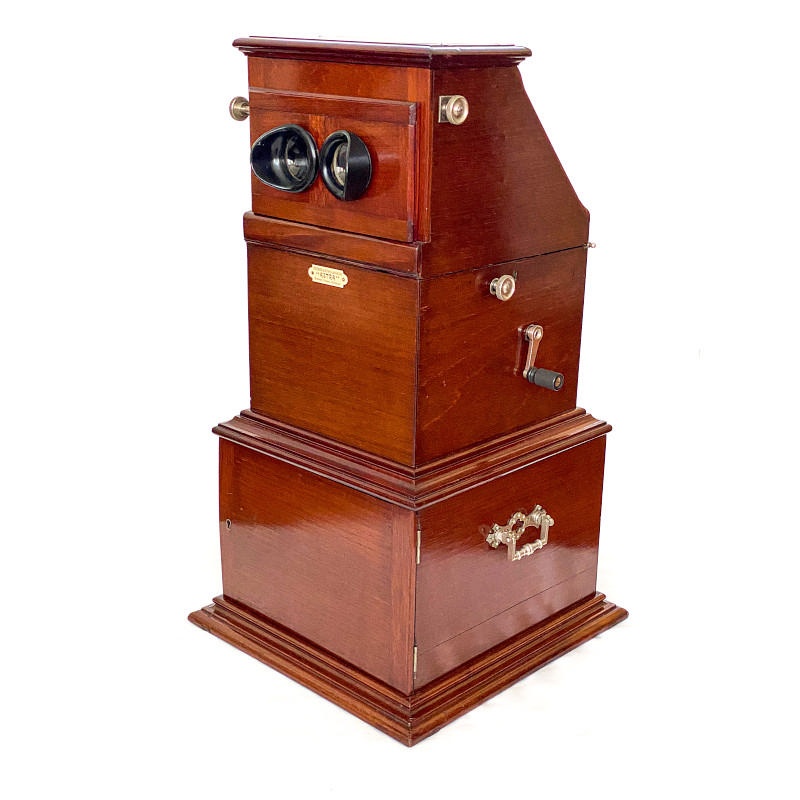
Tray-Stereoscope ‘Stéréo-Auto-Classeur “Astra“ ‘
Historical Context
Lucien Albert Bize was a pioneer in compact stereoscope innovation in early 20th-century France. In 1908, he introduced ‘Le Minimus’ and ‘Le Multiphote’, both featuring an ingenious simple mechanism. Bize’s stereoscopes were initially manufactured by Maison Gustave Jacob in Paris until Jacob’s bankruptcy in 1911. Production continued under Bize until he sold his company to Robert Pleyau in 1913. The more conventional ‘L’Astra’ was introduced in 1913 even though the patent was still registered by Bize in 1912. The manufacturing of Bize’s stereoscopes likely ceased during World War I.
Details
L’Astra is the largest of Bize’s designs. The slide tray mechanism of L’Astra differs from typical stereoscopes. Instead of a tray carriage moving over a rail, L’Astra uses a gear system embedded in the base plate, with the tray featuring grooves. The rotating gear moves the tray smoothly forward, ensuring precise positioning of the slides. A tray can hold 24 slides. A knob on the left side allows navigation to a specific slide.
The base of the viewer contains two drawers with 3 trays each resulting in 144 slides in total.
Later models of L’Astra were designed to support the viewing of autochromes, with a special mechanism to accommodate the thicker glass plates used for color slides. There was also a version for 45x107mm slides.
Further reading: Stereoscopy History Series — Lucien Bize (A. Ruiter)
Date Made
Place Made
Period
Type
Manufacturer
Technique
Format
Medium
Related Patent
Series Title
Additional information or corrections are very welcome. Please send an e‑mail to mail@stereoscopicmuseum.org.