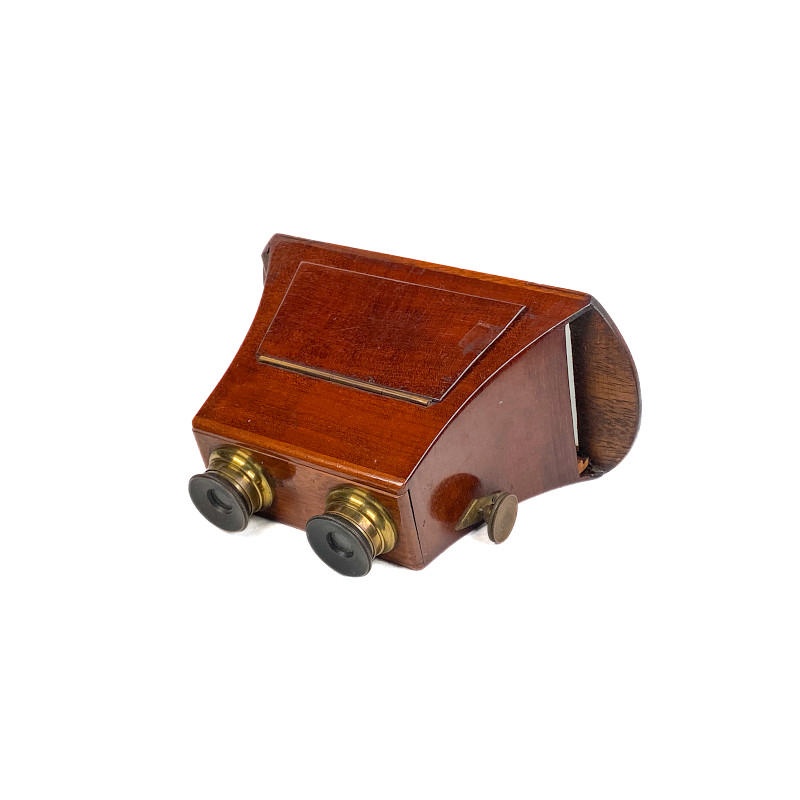
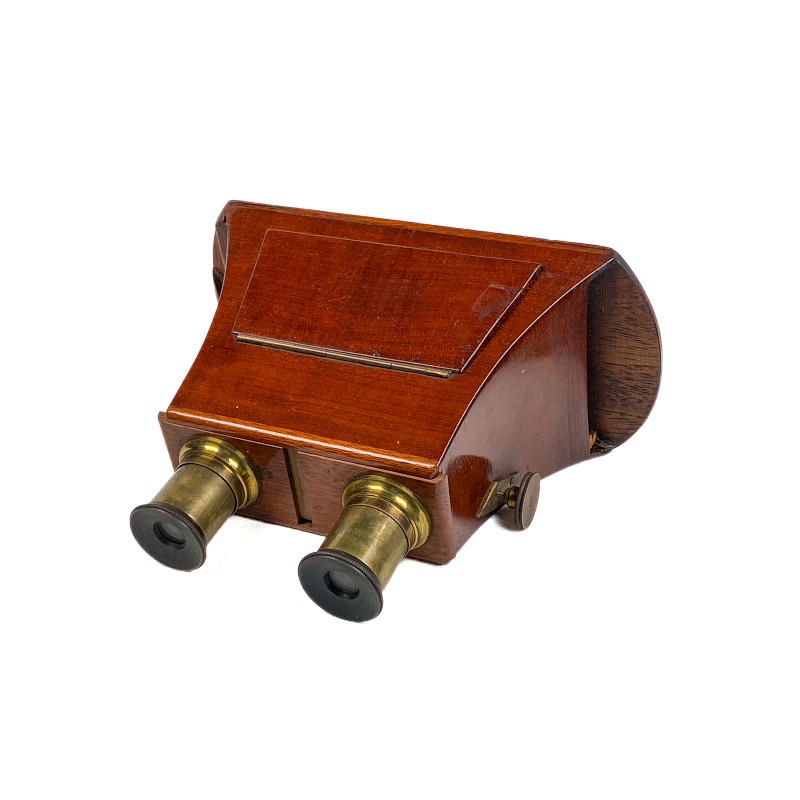
Name/TitleBrewster Stereoscope with Martin & Fay Focus Adjustment
About this objectA Brewster-type stereoscope is a refracting hand-held stereoscope introduced by David Brewster in 1849. The device was later developed into a viewer with an enclosed housing. This modification occurred largely in response to the use of daguerreotype stereoviews, which exhibited high surface reflectivity and therefore required shielding from ambient light. A hinged lid was added to the top of the viewer in order to direct incident light onto the daguerreotype and, subsequently, onto paper stereoviews. Jules Duboscq later incorporated a ground glass element to enable illumination of glass stereoviews by transmitted light.
(from: Compendium of Stereoscopes)
The illustrated viewer also features an early lens-tube focusing mechanism, patented by Antoine Jules Martin and Alexis Fay in 1855. To synchronize the movement of both lens tubes, they are connected by a metal piece inside the viewer. This element was later moved to the exterior, directly behind the ocular rings, resulting in the widely adopted design of later box-type viewers.
Place MadeEngland
Date Madec.1855
TechniqueSingle-view, manually
TechniqueFocus, lens tubes
Period1850–1892
Format8.5x17cm
Object TypeStereoscope
Subject and Association KeywordsFR 25785 (A. J. Martin, A. Fay, 1855)
Medium and Materialsopaque and transparent
Object numberM‑SH065
Copyright LicenceAll rights reserved
Additional information or corrections are very welcome. Please send an e‑mail to mail@stereoscopicmuseum.org.