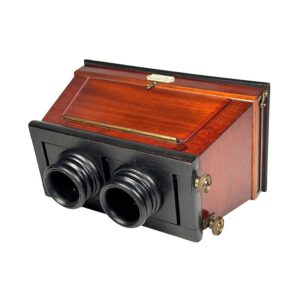
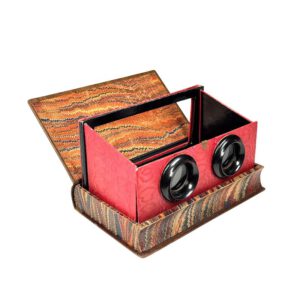
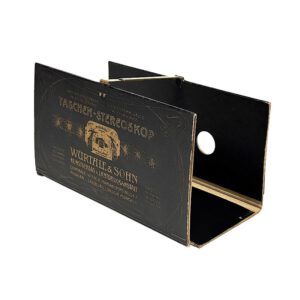
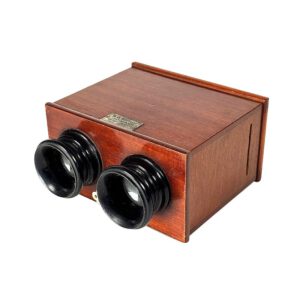
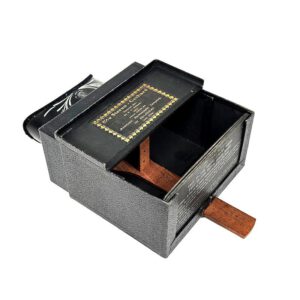
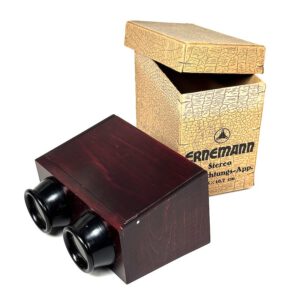
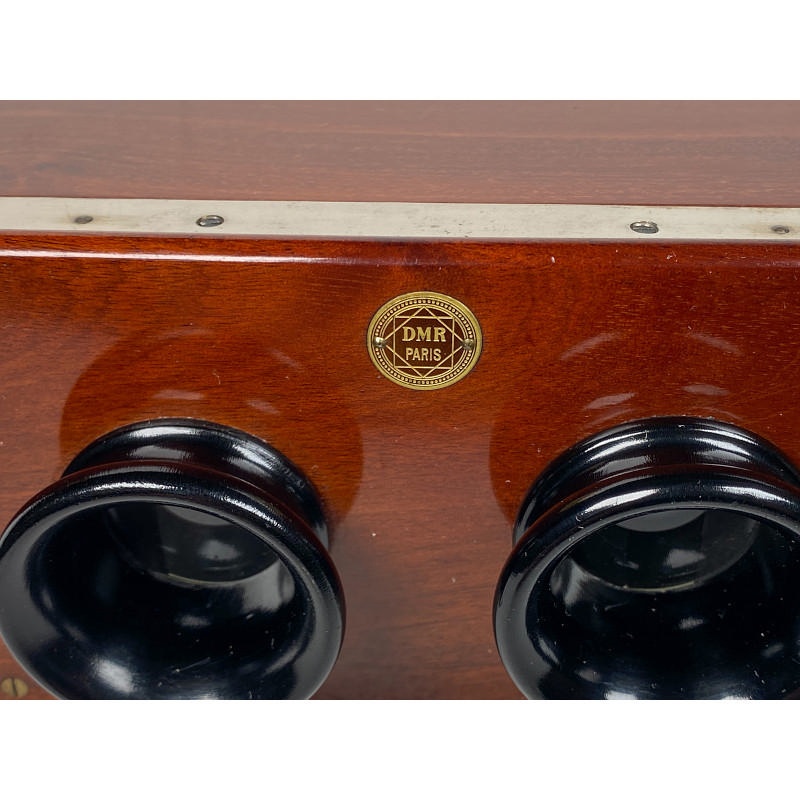
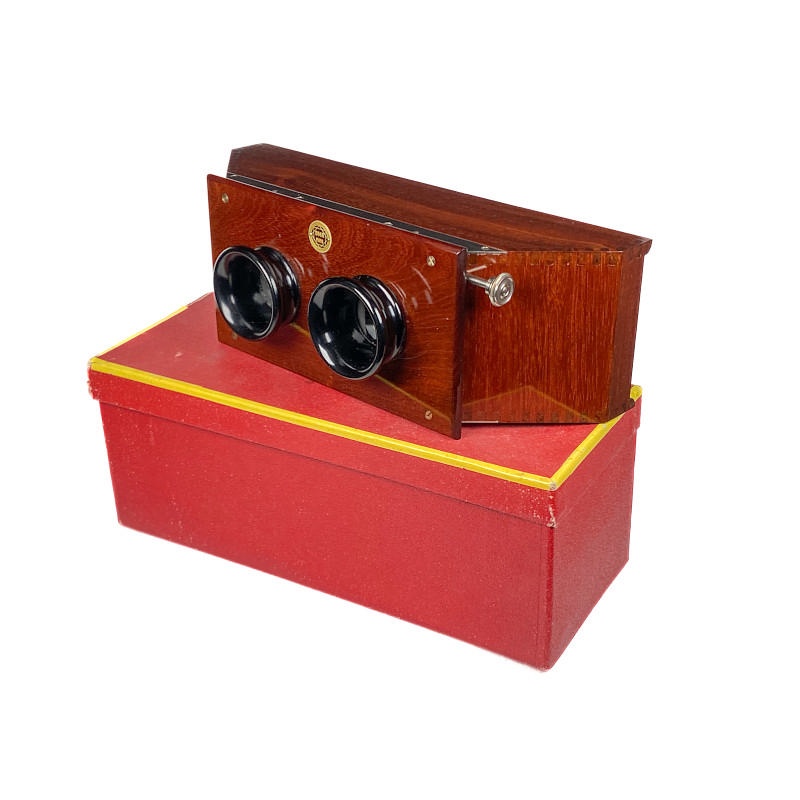
Stereotelescope ‘Stéréo-Project’, wooden version with original storage box
Details
The Stéréo-Project was presented to the French Photographic Society during its meeting of November 6, 1903. Its operation was as follows:
In stereoscopic projections, the two images are projected side by side onto a screen. To perceive the stereoscopic effect, each person must use a special viewing device that allows the two images to be superimposed, just as in an ordinary stereoscope.
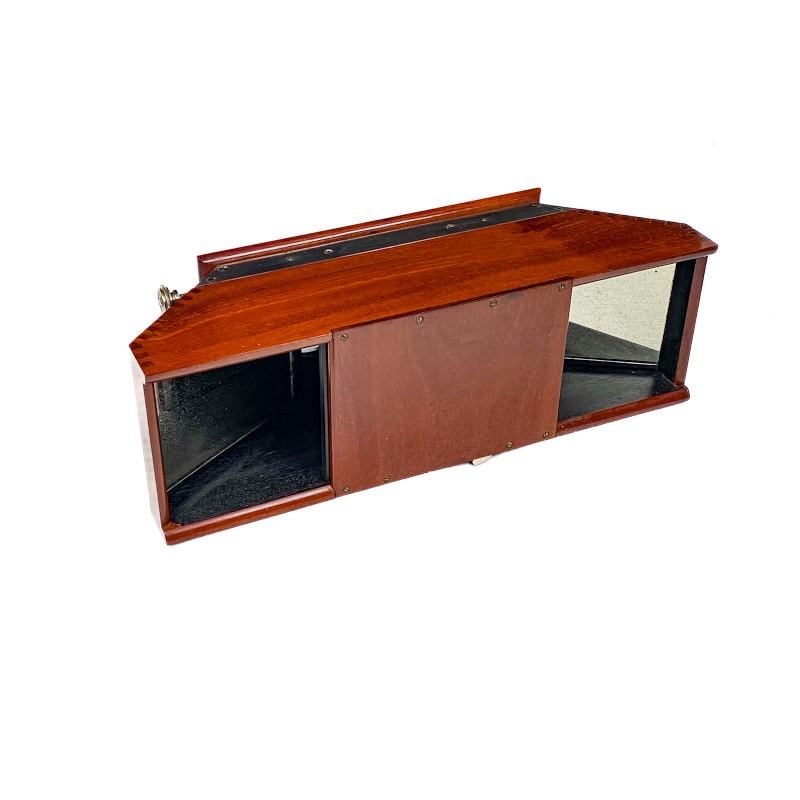
The Demaria Brothers Stéréo-Project, in its external appearance, resembles a conventional stereoscope. However, it contains two sets of mirrors. Two fixed mirrors inclined at 45° and two movable mirrors rotating around two axes, operated simultaneously by a metal knob. At the front are two movable diaphragm screens, adjusted by a lever, which can be moved closer together or farther apart.
Two eyepieces without lenses serve to guide the observer’s vision. Depending on the distance and position of the observer, and the size of the projected images on the screen, the angle of the mirrors must be adjusted so that the two images overlap in the viewer’s perception, creating the stereoscopic effect.
(from: Moulinier et al. Histoires de visionneuses stéréoscopiques françaises. Limoges, 2025, p. 57. Author’s translation.)
Historical Context
The Demaria company was founded in 1858 by Isidore Demaria and became Demaria Frères when it was taken over in 1897 by his three sons: Jules, Henri, and Paul.
Their field was photography, ranging from single-image and stereoscopic cameras to projection equipment and laboratory apparatus. In this context, they introduced in 1903 an unusual device designed for the projection of stereoscopic images. Research to locate a corresponding patent has so far been unsuccessful.