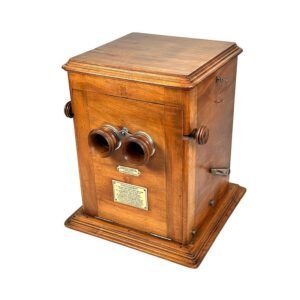
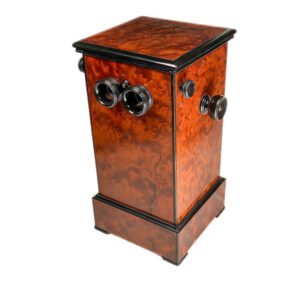
Stereoscope ‘Kromskop Color Stereoscope’ with Image Set
Details
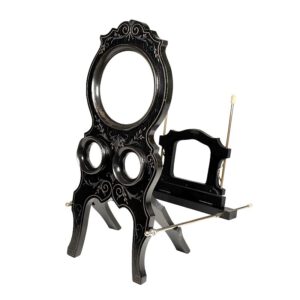
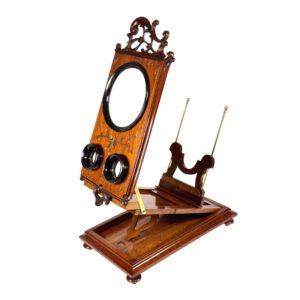
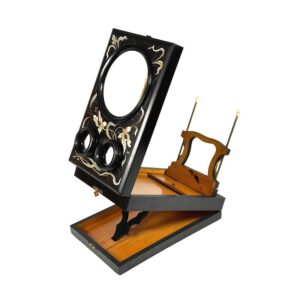
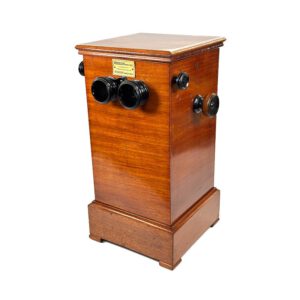
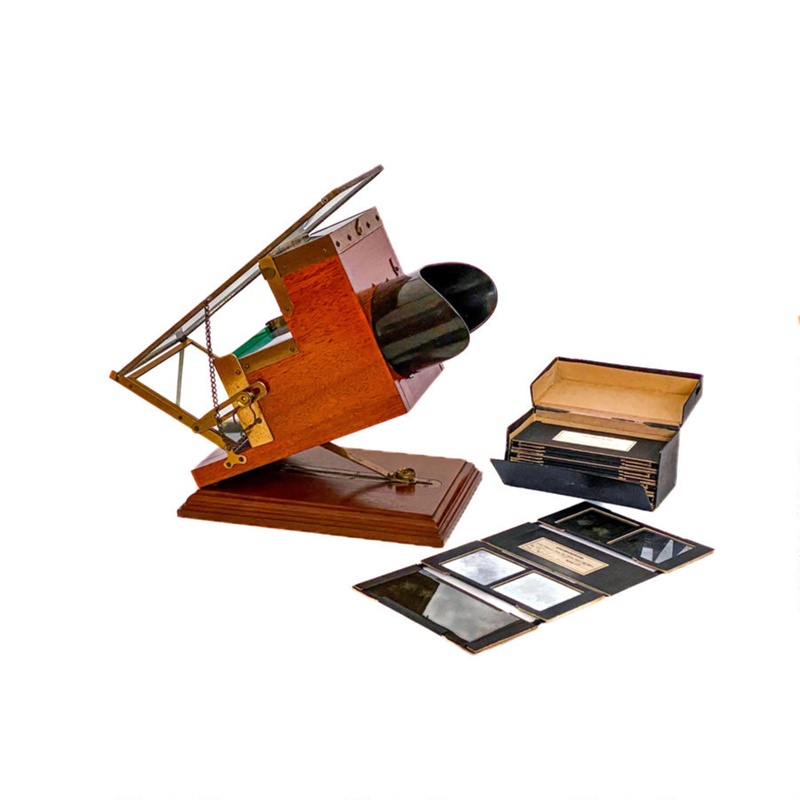
The Kromskop was an early colour stereoscope developed by Frederic Eugene Ives. It was part of Ives’s Photochromoscope system and was intended to reproduce photographs in both natural colour and stereoscopic depth.
The system used special images called Kromograms. A Kromogram did not contain a single colour photograph. Instead, it consisted of three black-and-white stereoscopic image pairs, each capturing one colour component: red, green, and blue-violet.
In use, the Kromogram was placed inside the Kromskop. The instrument illuminated each image through a corresponding coloured filter. Transparent reflectors then combined the three filtered images optically, so that the viewer perceived one full-colour stereoscopic image.
The quality of the colour reproduction was widely admired, but the system was mechanically complex and expensive. It required special cameras, carefully prepared Kromograms, and a dedicated viewing instrument. For this reason it remained a specialised system rather than a mass-market photographic process. Its commercial relevance declined after the introduction of the Autochrome process in 1907, which made colour photography simpler and required less specialised viewing equipment.
(from: Compendium of Stereoscopes)