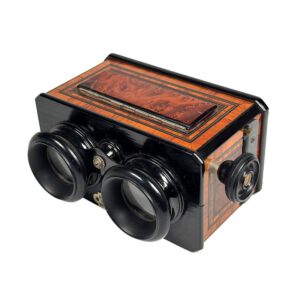
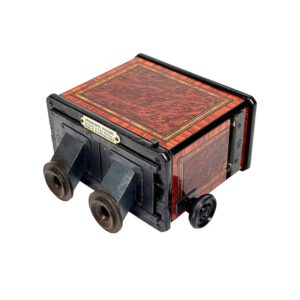
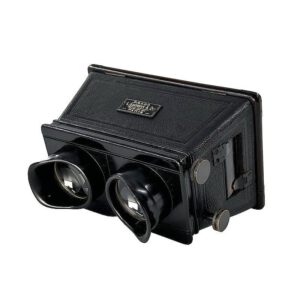
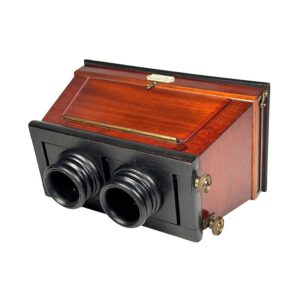
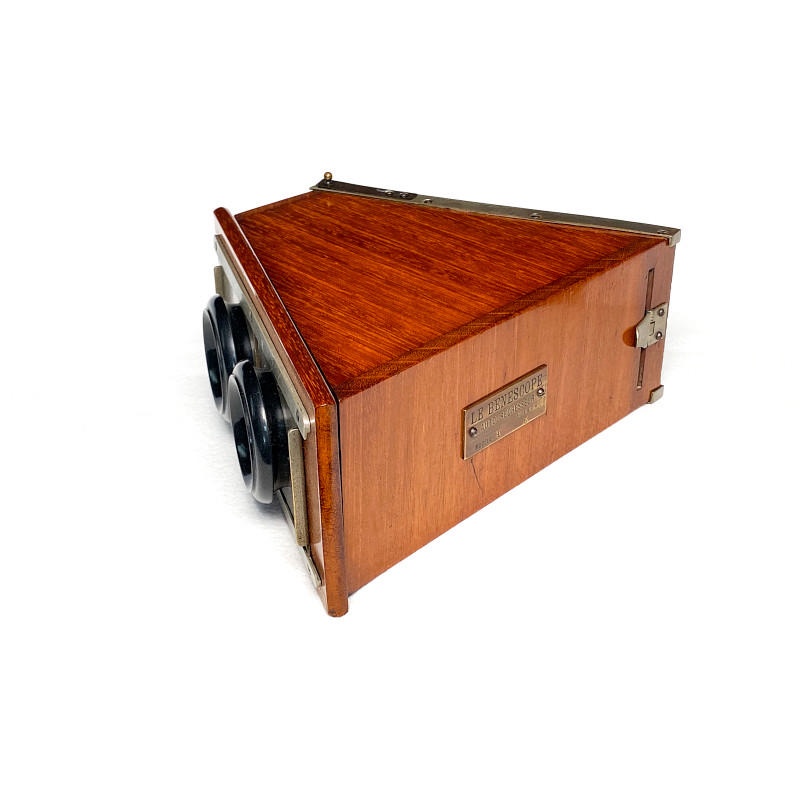
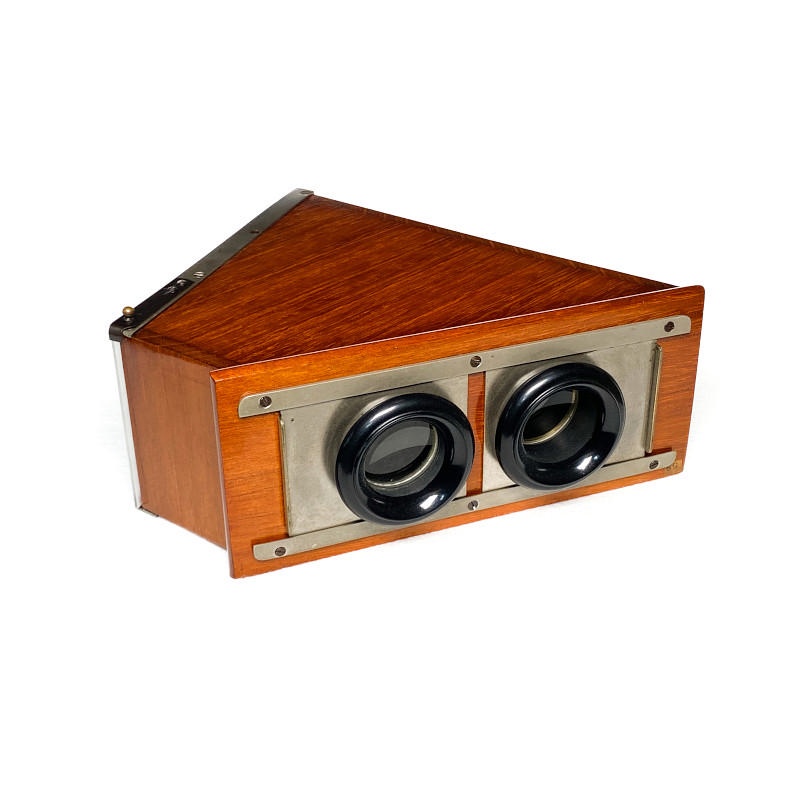
Prism Stereoscope ‘Le Benescope. Auto-Redresseur’
Details
Georges-Adolphe-Emmanuel-Pierre Balmitgère was born on September 3, 1871, in Algiers, and died on November 4, 1918, at the age of 47. Very little is known about him, except that he became interested in stereoscopy and filed three patents and two additions between 1907 and 1909, with a final one in 1918, six months before his death.
The problem that would lead Balmitgère to file his patents about stereoscopic photography, which already had its standards, defined formats, and a standard process to realise positive slides, is connected to the Autochrome plates by Lumière, which appeared on the market the same year, 1907. These, because of their composition of a three-coloured filter and a black-and-white negative, could only be directly developed into a positive, keeping either their inverted position or requiring them to be cut for a rearrangement of the images to allow classical stereoscopic viewing. Balmitgère’s solution is an optical inversion covered by patent FR400318 of January 27, 1909.
The stereoscopes designed by Georges Balmitgère were constructed by Mattey and appear in the catalogs of this manufacturer from the period, but only around 1920.
The Benescope ‘Auto-Redresseur’ is a very simple wooden construction with no particularly distinctive design. Its only notable feature is the interocular adjustment system. Notably, the left ocular uses a mirror, while the right uses a prism with a specific optical formula to compensate for the viewing distance and provide both images with exactly the same magnification.
Available in formats 45x107, 6x13, and 8x16. The model name remains a mystery.
(from: Moulinier et al. Histoires de visionneuses stéréoscopiques françaises. Limoges, 2025, p. 192. Author’s translation.)