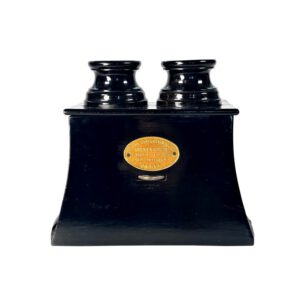
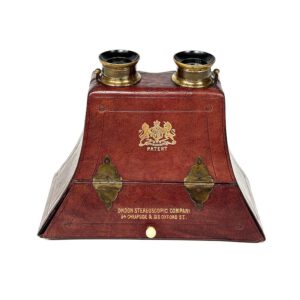
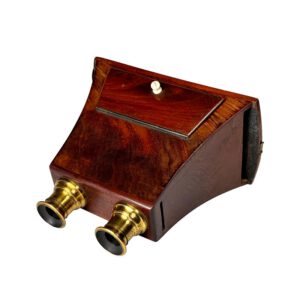
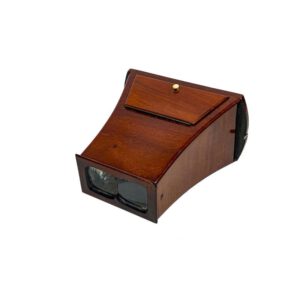
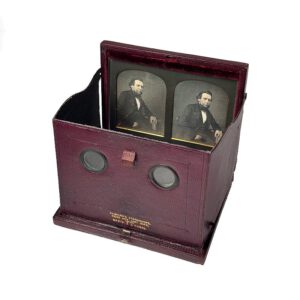
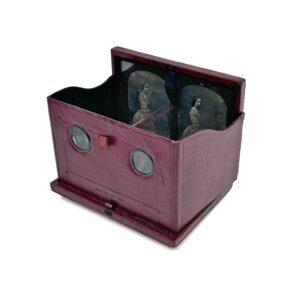
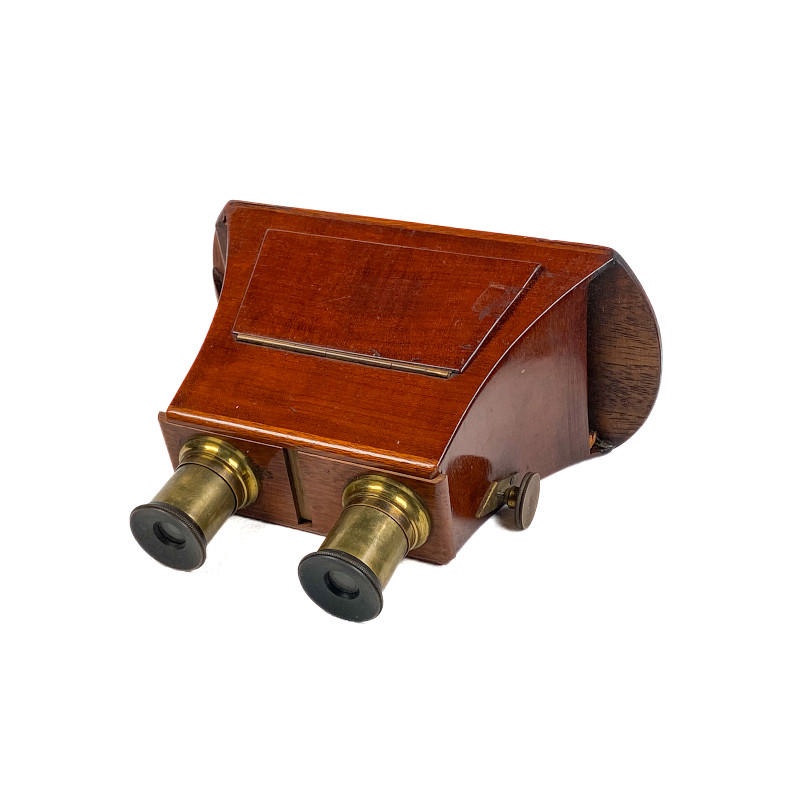
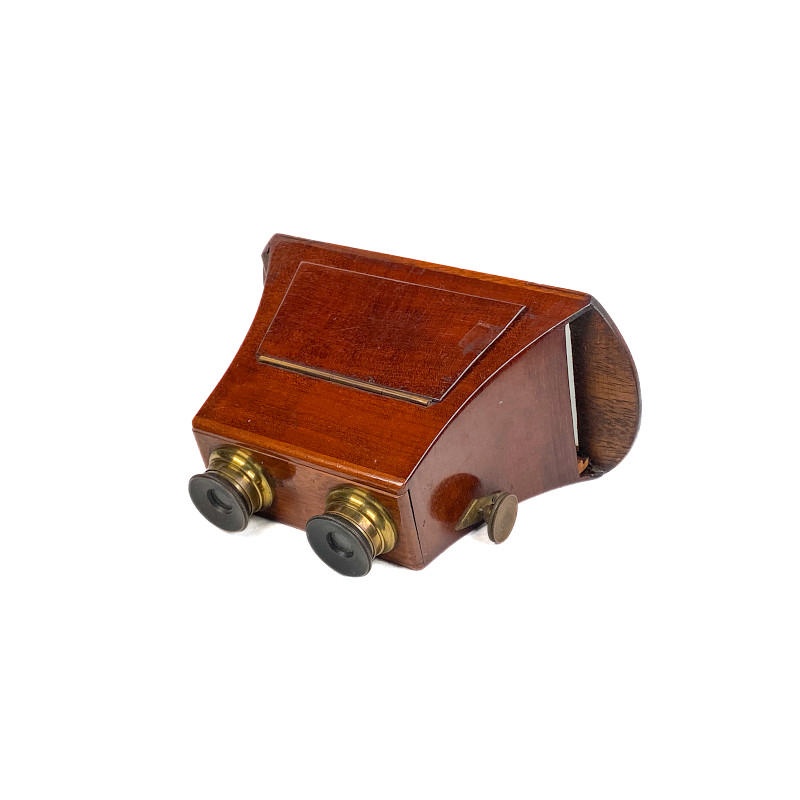
Brewster Stereoscope with Martin & Fay Focus Adjustment
Details
A Brewster-type stereoscope is a refracting hand-held stereoscope introduced by David Brewster in 1849. The device was later developed into a viewer with an enclosed housing. This modification occurred largely in response to the use of daguerreotype stereoviews, which exhibited high surface reflectivity and therefore required shielding from ambient light. A hinged lid was added to the top of the viewer in order to direct incident light onto the daguerreotype and, subsequently, onto paper stereoviews. Jules Duboscq later incorporated a ground glass element to enable illumination of glass stereoviews by transmitted light.
(from: Compendium of Stereoscopes)
The illustrated viewer also features an early lens-tube focusing mechanism, patented by Antoine Jules Martin and Alexis Fay in 1855. To synchronize the movement of both lens tubes, they are connected by a metal piece inside the viewer. This element was later moved to the exterior, directly behind the ocular rings, resulting in the widely adopted design of later box-type viewers.